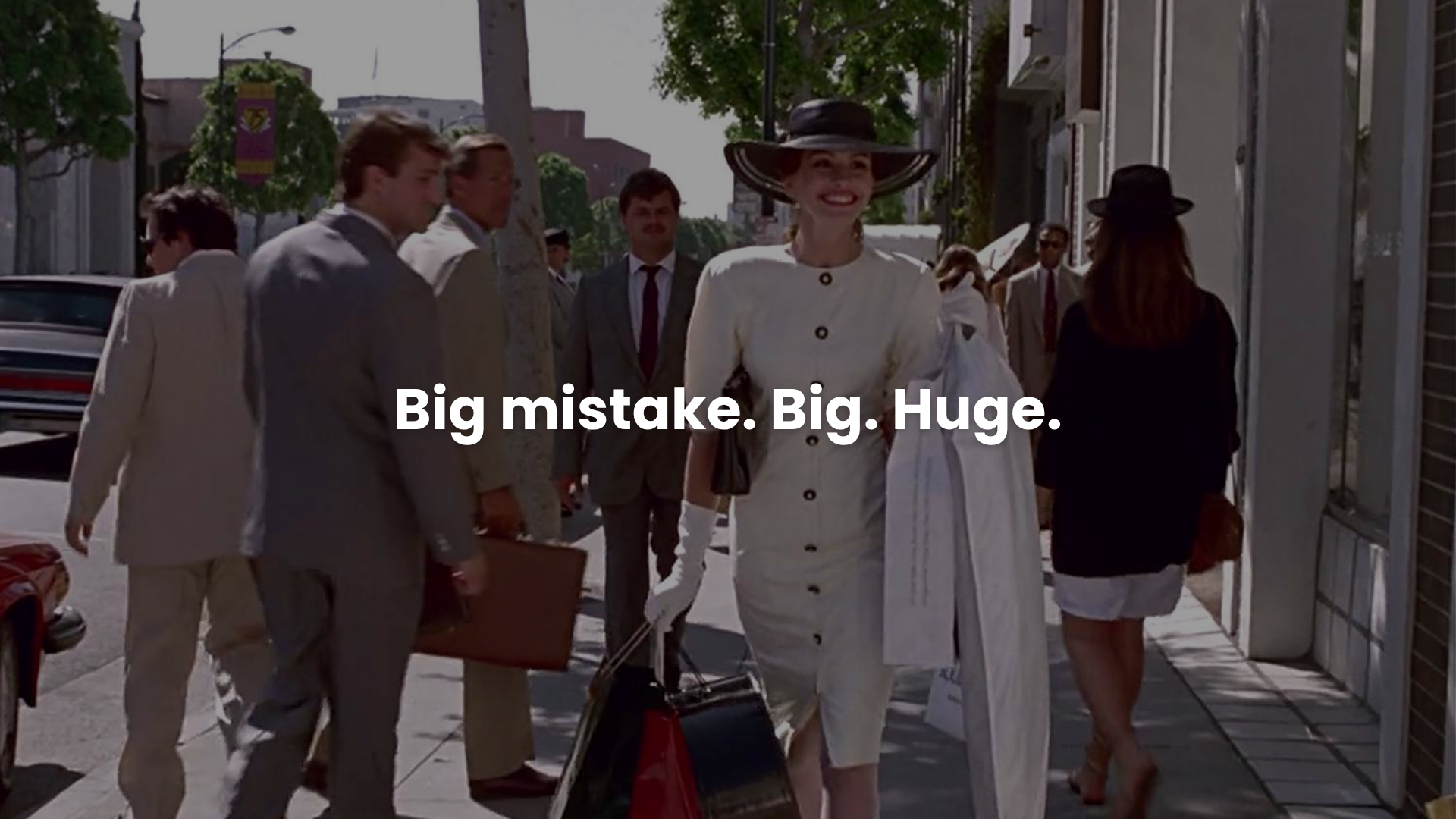
The Rodeo Drive rejection
Vivian Ward walks onto Rodeo Drive with cash in her bag, a real reason to be there (a business dinner, that same evening) and no idea that she’s about to be made to feel two inches tall. She makes her way to the first boutique hopeful. She comes out of it even smaller. Then the next one. Then the next. It’s horrendous - the specific, bored, up-and-down glance the sales assistant gave her, that decided who she is before she even opened her mouth. By the third or fourth shop she’s not shopping any more, she’s just trying to leave without crying.
Barney’s phone call fixes everything
Meet Barney.
Barney runs the Beverly Wilshire, and when he sees how badly the day has gone, he doesn’t hand Vivian a new dress and send her back out there to try again. He makes calls. Before she arrives at the next shop, it already knows she’s coming.
Nothing about Vivian changed between the two shopping trips except that told the shop she was coming. The rejection was far less likely once she was expected.
To be clear, Barney isn’t literally handing the boutique a customer profile or a declared-intent record, it’s just a film, and I’m trying out this metaphor for size. But the mechanism he sets in motion is the same shape as one: he changes the information the retailer has before Vivian arrives.
That doesn’t guarantee good service though. A shop that knows a customer’s name, appointment time and reason for visiting can still get the moment wrong. But it changes the starting point. The second shop is replacing the guesswork and assumptions with information.
What is shop-by-appointment retail?
Shop-by-appointment retail is when a customer books a specific time slot, in advance, to shop with a retailer (in person or virtually) rather than arriving unannounced.
On its own, a booking mostly answers the when: a name, a time, a service. It doesn’t automatically tell a retailer why someone’s coming. That takes a booking journey designed to ask. But get that right, and a simple time slot becomes something closer to declared intent: the who, what, and why, not just the when.
That’s closer to what Barney’s phone call did for Vivian: providing enough advance information to change what the shop assistant walked into the interaction knowing.
“You work on commission, right?”
Vivian goes back to the shop that turned her away, loaded with bags from every boutique that didn’t, and gets to deliver the infamous line: “You work on commission, right? Big mistake. Big. Huge.”
It’s satisfying because we’ve all wanted to say a version of it to someone who wrote us off too fast. But for anyone who runs a shop rather than just watching films about one (like I do), it’s Barney’s role that’s more impactful and useful. He didn’t change Vivian, he changed what the store knew about her before she arrived.
Appointment shopping itself isn’t new. Luxury shopping, bridal fittings, beauty consultations, and tailoring have worked this way for years; Harrods partnered with Appointedd back in 2021. But now retailers treat the information that slot generates as a strategic asset worth designing the whole visit around.
Who’s already booking it
Charlotte Tilbury scaled bookings 235% quarter-on-quarter, powering more than 100,000 appointments across in-store fittings, virtual consultations and global masterclasses.
Moss (outfitting customers for weddings, interviews, and everything in between) grew bookings 80% and took over 45,000 appointments in a single quarter across 100+ stores.
Charles Tyrwhitt saw online bookings jump 48% in its first three months of appointment booking, with appointments now driving 11% of total revenue.
Victoria’s Secret reinvented its bra fitting service around booking and hit a 100% conversion rate from appointment to sale, with an average basket of £109.
Four retailers adding appointments is the easy headline. But what they’re using them for is really interesting: beauty consultations, occasion-wear, tailoring, bra fitting, personal shopping. Each retailer knows more about who’s coming, and why.
What the retailer does with that information
It doesn’t really work if a booking just sits in a calendar. The commercial upside comes from what a store does with the advance notice, before the customer sets foot in the shop.
- Match the customer with the right associate for what they need.
- Prepare relevant products, sizes, or alternatives in advance.
- Plan stock and store capacity around expected demand.
- Personalise communication ahead of the visit.
- Prioritise high-value or time-sensitive appointments.
- Measure what customers really came in looking for.
- Learn what demand is coming before it reaches the shop floor.
This is how appointments change the way a store operates.
Retailers designing around intent
Saks Global’s recent work is digital personalisation: testing intent-based “we already have a sense of why you’re here” homepages instead of generic ones. The test lifted conversion by 9.5% and revenue per visitor by 7%, without a human being involved at all.
It’s worth mentioning because it shows the same underlying shift from a different angle: retailers are moving away from treating every visitor identically, and starting to use what they know (inferred or declared) to make the experience more relevant. Saks is working with inferred intent, guessed from browsing behaviour. A booking is declared intent: the customer said so themselves.
Appointedd’s own data shows what the difference is worth. In some appointment-led retail categories, conversion approaches 100% against a typical 2-4% for unannounced walk-ins. Victoria’s Secret, for example, converts 100% of its booked bra-fitting appointments into a sale. It’s proof that a booking is a stronger signal of intent than anonymous visit.
Big mistake if you don’t
I’m not arguing for making every shop appointment-only. Walk-in traffic is still where retailers discover new customers, fill quiet afternoons, and catch the person who wasn’t planning to buy anything until they saw it in the window. Appointments sit alongside that: a second lane for the customer willing to tell a retailer more before they arrive.
The only thing Vivian needed, in the end, was the shop to know she was coming before she got there. The value of the appointment is that it gave the retailer information before the customer arrived, and information changes what the store can do with the visit.
Retailers running an appointments desk this year have basically worked out the same thing Barney knew: don’t make your team start every interaction from zero when the customer’s willing to tell you more in advance. Big mistake if you don’t. Big. Huge.
Quick answers
What is shop-by-appointment retail? A model where customers book a specific time slot in advance to shop in person or over video, so the retailer knows who's coming and why before they arrive.
Is appointment shopping a new retail trend in 2026? Its not new - luxury personal shopping, bridal, beauty and tailoring have booked appointments for years. What's expanding is its role: more retailers, across more categories, treating the booking itself as a source of customer intent rather than just a calendar slot.
Does appointment shopping actually increase conversion? In some appointment-led categories, Appointedd data shows conversion approaching 100%, against a typical 2–4% for unannounced walk-ins.
Which retailers use Appointedd for appointment booking? Charlotte Tilbury, Moss, Charles Tyrwhitt, Victoria's Secret and Harrods all run bookable appointment services powered by Appointedd, spanning beauty, menswear and personal shopping.