
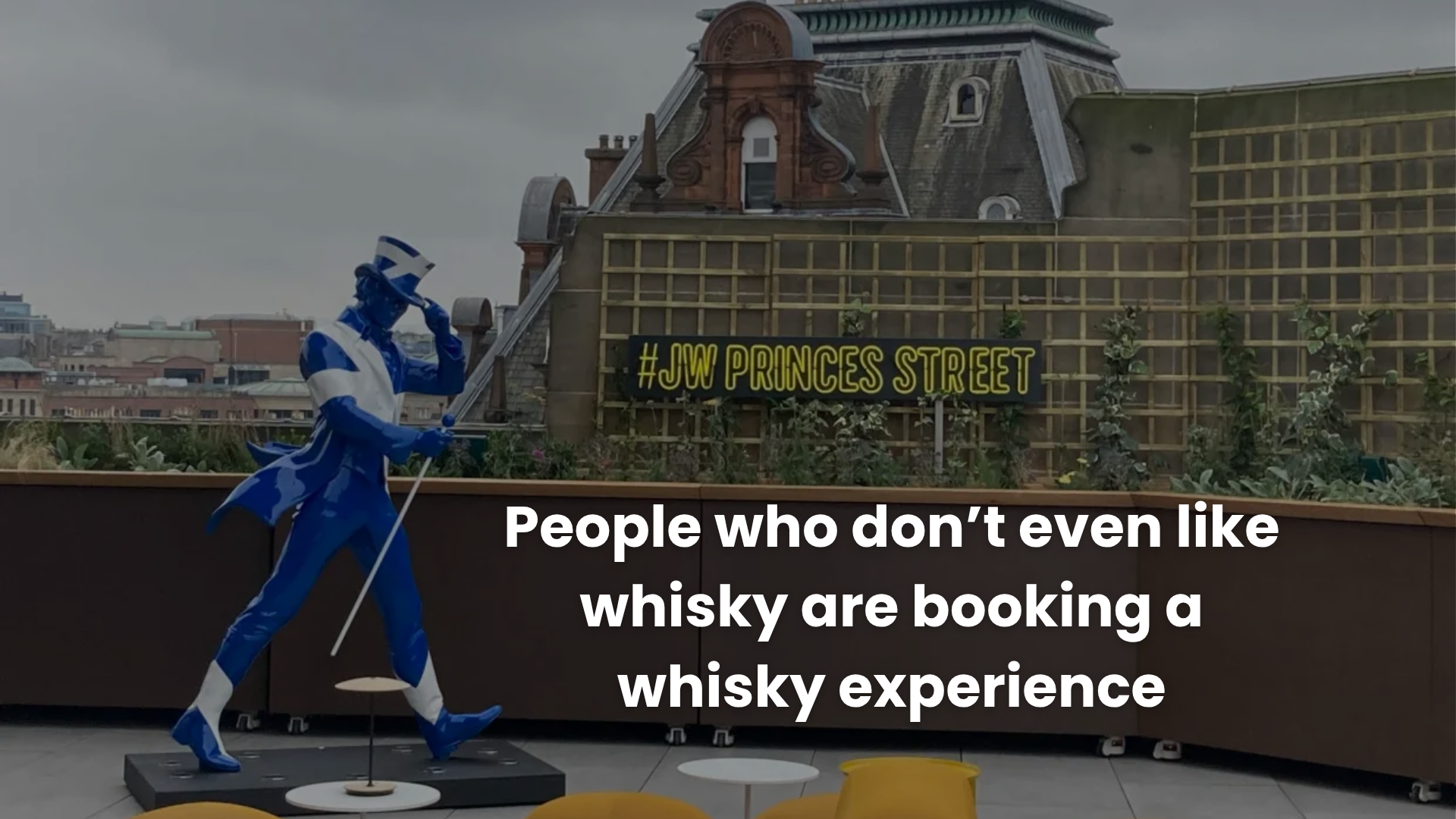
There’s a historical building on a street corner in Edinburgh’s West End that looks like something out of a theatrical show rather than a shop or bar. It stands tall and proud, lit up in that dramatic way that immediately draws your attention from anything else, quite the task when you have Edinburgh Castle across the road.
The building that used to be a House of Fraser is now a three-storey immersive experience built around the making of whisky and Johnnie Walker’s 200-year blended history, topped with a rooftop bar, that has locals booking tables months in advance.
When I spoke to the team at Appointedd about who had been, the meeting became a mass of excited chatter, discussion of what their favourite part was, that the view of Edinburgh at the top was one of the best there is, one guy even used to work there, and then another said that he didn’t actually like whisky but he went and he had an epic time.
The experience is built to make that possible. Before you taste a drop of whisky, you answer a flavour quiz about whether you lean smoky or sweet, spice or citrus, and it feels less like the start of a whisky tour and more like a personality test. 90 minutes later, you’ve walked through cinema-scale rooms that dramatise how a blend gets made, stopped twice to taste whiskies chosen for your specific answers, and chosen (at each stop) whether you want it neat or built into a highball. By the end, you’ve essentially been taught your own perfect serve, and it gets built right in front of you.
The doors then open onto 1820, the rooftop bar, and you’re met by Edinburgh Castle while someone hands you a cocktail built around the whisky you’ve learnt you like best. It’s picked up World’s Leading Experience at the World Travel Awards since opening in 2021, the centrepiece of a reported £185 million investment Diageo has put into Scotch tourism.
The longer I thought about it, the more the whisky felt beside the point. What stayed with me (besides one of the best cocktails I’ve ever tasted - the Black Ruby Negroni for those of you asking) was how much the place had learned about me by the time I left.
Your flavour quiz answers are a confession booth with a rooftop view
Strip away the theatre and this is what actually happens: a brand collects exact, first-hand, freely given information about what one specific person likes to drink, how they like it served, and what they’ve chosen to experience. It’s different from the signals retailers usually have to infer; browsing history or guesses from a loyalty card. Here you tell them directly, on paper, at a tasting bench, because you want to.
I’m obviously talking about declared intent (I usually am): information a customer hands over directly, rather than data a brand has to piece together from browsing behaviour. Though at this stage in the visit it’s really declared preference: what you’ve responded to, not necessarily what you’re about to buy.
Someone floated a version of what comes next to me in the office last week: imagine that information followed you out of the building. The follow-up message changes from a “thanks for visiting” which might never be opened, to a message that turns up where you might make your next purchase: in the spirits aisle at the supermarket, or the duty-free shelf on the way home. You had the Black Ruby built into a negroni at 1820. This is the exact bottle, the mixer, and the garnish you chose. It’s not a discount code, or a “something you might like”, it’s the precise thing that you already showed them you preferred.
It’s working from a fact. Yet a lot of retail “personalisation” still runs on inference: browsing behaviour, a postcode, a vague affinity score. This idea skips past all of that. There’s no flirtation, they literally pay for the experience and they tell you what they respond to.
The House of Guinness
Swap “whisky” for “whiskey”, and we’ve gone Irish. Johnnie Walker isn’t an isolated example. Guinness built an entire attraction around the same idea: get people immersed in the product, then send them home with a story about it.
The Guinness Storehouse has occupied a corner of St James’ Gate since 2000, and it’s Ireland’s single most-visited attraction, drawing around 1.7 million people a year, all of whom end their visit in the same place: the Gravity Bar, with a full 360-degree view of Dublin and a pint they’ve just been taught how to pour perfectly.
The tour itself is more like a pilgrimage. You don’t visit Dublin without doing it, or without being told you have to, and that’s the result of two decades spent building an experience so specific to one city that it became part of Ireland.
It’s sitting on just the same untapped moment as Johnnie Walker. Everyone who pours their own perfect pint at the top has just spent the best part of two hours actively engaging with the brand and the product. What happens to everything you’ve learned about that person once they’re back at the airport, 20 minutes from boarding, walking past a fridge of cans, or once they’re home wanting to show their friends a piece of Ireland, bar snacks included? I couldn’t help but wonder.
I don’t even like whisky
Back at the top of 1820, you didn’t need to like whisky to have a brilliant time. But by the time you left, you’d told Diageo more about your taste in a drink than most loyalty cards manage in years.
That’s what’s sitting inside every experience like that, not just the ones with a rooftop view, though most of them do seem to have one. The moment someone chooses to show up and take part is the moment they hand over the truth about what they’re interested in next. That truth usually gets filed away as an operational detail, a name on a guest list, a slot in the diary, and disappears once the person has left. Perhaps they’ll be invited to try a new flavour, or be welcomed back with a small but enticing offer. But it won’t be anything to do with what they’ve actually told you.
I think the interesting part in all this is that someone who didn’t think of themselves as a whisky drinker (heck, I’ve had to correct the spelling of whisky in this article more times than I care to admit) walked out having learned exactly what they liked, and Diageo already knowing it too.
After all that, I’m off to make a Black Ruby Negroni.
Quick answers
What is the Johnnie Walker Princes Street Experience?
A ticketed visitor attraction in Edinburgh that opened in 2021 as the centrepiece of a reported £185 million Diageo investment in Scotch whisky tourism. It runs a roughly 90-minute guided tasting built around a personal flavour quiz, and ends at the 1820 rooftop bar overlooking Edinburgh Castle.
What is the Guinness Storehouse?
Guinness’s flagship visitor attraction at St James’s Gate in Dublin, open since 2000. It’s Ireland’s most-visited tourist attraction, drawing around 1.7 million people a year, most of whom finish their visit at the Gravity Bar, with a self-poured pint and a 360-degree view of the city.
Do Johnnie Walker or Guinness actually retarget visitors like this?
I haven’t found evidence that either brand currently does this in the way described here. The retail media example in this piece is a thought experiment about what could be done with the preference data these experiences already collect at the tasting bench or the tap, not a description of an existing campaign.
Why don’t you need to like whisky to enjoy the Johnnie Walker Experience?
The tour builds a personalised serve, including highballs and non-alcoholic options, around a flavour quiz taken at the start, so the format doesn’t assume you’re already a whisky drinker walking in.
What is declared intent in retail?
Declared intent is information a customer volunteers directly to a brand, such as a flavour preference or a booking request, rather than data the brand infers from browsing behaviour, footfall, or past purchases.

.png)
.avif)