
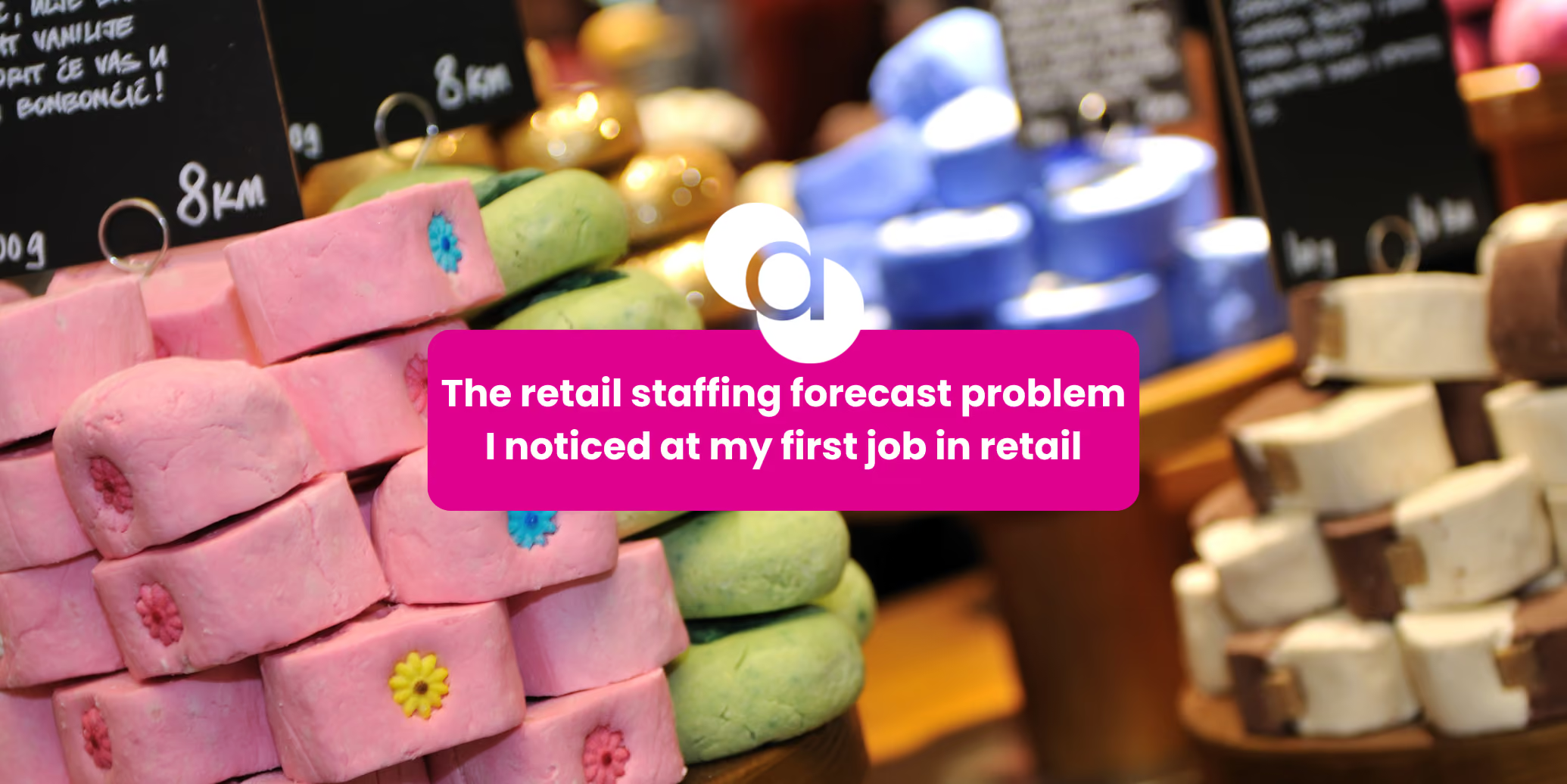
It’s 2008. I’m standing in Lush, in the Metrocentre, Gateshead (arguably the most sensory-overwhelming retail environment in the UK) surrounded by bath bombs, a counter of Fresh Face Masks living on mountains of crushed ice, and a cloud of Karma perfume so thick it’s permanently fused with my hair and clothes. Leona Lewis’s “Bleeding Love” is playing for what feels like the 47th time that day (it wasn’t my turn to choose the music from the iPod Nano).
We have one boss that rules us all (even our manager), the footfall counter across the door. This will determine if we hit our bonus (its only use to those of us on the shop floor) but it’s also forecasting how busy we’ll be next week.
Some Saturdays, the counter would hit critical mass and we’d have five of us simultaneously trying to give a skin consultation, wrap a massage bar as a gift, explain to a bewildered dad why the face masks needed refrigerating, and stop a toddler from licking a Butterball. Manic, brilliant, chaos (and we hit our target). Other Saturdays we’d be leaning on the counter with nothing to do, playing I Spy out of the Metrocentre window while Duffy’s “Mercy” floated through the speakers (still not my turn on the iPod) and we contemplated rearranging the Sweetie Pie shower jellies for the second time that shift.
There was no signal, no way of knowing in advance which Saturday it was going to be. Just the footfall counter, last week’s numbers, and a slight feeling of dread.
But that was 17 years ago. You’d think the retail staffing forecast problem would have changed a lot more by now…
The true cost of getting staffing wrong
Every workforce planner in retail knows the mismatch I’m describing. The tools have evolved (footfall counters are now paired with transaction data, seasonal models, scheduling software) but the underlying challenge still remains. You’re building a staffing plan in advance and hoping the demand curve shows up to match it.
Overstaffing costs the obvious: wage spend on hours that generate no revenue. Understaffing costs more, and differently. Research shows that a customer who can’t get served within the first three minutes of entering a store is more likely to leave without buying.
But the real cost is rarely framed this way at board level. A forecast that is 10% wrong is not simply a labour efficiency problem. It’s a revenue allocation problem. When high-intent customers arrive and the floor isn’t ready for them, the loss shows up in transaction data days later, disconnected from the staffing decision that caused it, and invisible to the people who made it.
I experienced the Lush version of this constantly. The busy days, with not enough of us on the floor, customers getting impatient waiting for a demonstration, walking around the shop sheepishly then becoming frustrated and walking out the door, clicking that footfall counter as they left (one less person served, one less sale to help hit our targets). But no one was measuring the lost basket value. We just knew that it was happening, we could literally see it but couldn’t do much about it as we hadn’t seen it coming.
Workforce planners are doing an amazing job, but they’re being asked to forecast demand using the wrong signals.
From inferred to declared: why most retail demand signals are working against you
The signal that matters here is declared, not inferred.
Most demand signals in retail are inferred. You look at website traffic and infer purchase intent. You look at email open rates and infer engagement. You look at footfall patterns and infer when you’ll be busy. These are useful signals, but they’re probabilistic. You’re working with odds.
Every signal we had at Lush in 2008 was inferred. Busy shopping centre on a bank holiday weekend? It was probably going to be hectic. Post-Christmas lull in January? Probably quiet. Raining outside? We all know what happens to the Metrocentre then (it becomes chaotic). But “probably” is not a staffing plan.

A booking is different. When a customer books an appointment at your store (whether for a styling consultation, a watch service, a personal shopping session, or an event) they have declared their intent. They’ve told you: I am coming. I am coming at this time. I want this experience and I’m ready to spend.
We call this type of signal Booked Intent®: structured, timestamped, named signal that a specific person is going to walk through your door with a defined purpose. For a workforce planner, it’s one of the clearest and most actionable demand signals available.
To be clear: booking data doesn’t replace traditional forecasting inputs. Weather still matters. Promotions still matter. School holidays, local events, delivery volumes, returns - all of it still shapes the day. What booking data does is improve forecast quality, because it’s one of the only demand signals based on customer commitment rather than probability.
The 5Ws: what a booking tells your retail workforce planning team
A booking answers every question a staffing brief needs to answer. Who is coming (a named customer with CRM history attached). What they want (the service or product category they’ve booked). When they’ll arrive (the exact time slot). Where they want to be served (specific store, floor, or department). Why they’re visiting (declared purpose, not inferred interest).
Compare that to a footfall counter, which tells you how many people came in. Not which people, or what they wanted, or how long they intended to stay.
In 2008, if someone had told me I’d one day be able to know in advance that a specific customer was coming in at 2pm on Thursday, that she was looking for a new shampoo, that she suffered from sensitive skin and dandruff, had tried a particular product before but wanted something slightly different, I wouldn’t have been staring blankly out of the window. I would have been preparing the perfect selection of products instead. But we found out who the customer was as they walked through the door, and we improvised.

When you aggregate booking data across a store (or across a portfolio of stores) you get something that functions as a proper staffing brief. Demand peaks become visible 48, 72, or 96 hours before they happen. Departments under pressure show up in advance. Associates carrying too many appointments and those with spare capacity are both visible. A retail staffing forecast built on what customers have already told you looks very different to one built on hope and a seven-day transaction average.
What traditional retail staffing forecasts get wrong
Most retail staffing forecasts are built backwards. They start with last year’s data, apply a seasonal multiplier, factor in any known trading events, and arrive at a headcount figure. It’s logical, but reactive.
Historical data tells you what happened, not what’s about to happen, and in a retail environment shaped by omnichannel behaviour, that gap is getting really hard to ignore.
Our footfall counter was the 2008 version of this model. It told us how many people came through the door. But it couldn’t tell us why they came, what they wanted, how long they planned to stay, or whether they were the sort of customer who needed 45 minutes with a knowledgable associate or just wanted to grab a gift set from the shelf and head home. Every day was a new gamble. We’d text the manager from our Blackberry if we were unexpectedly busy, pleading for another staff member to come in.
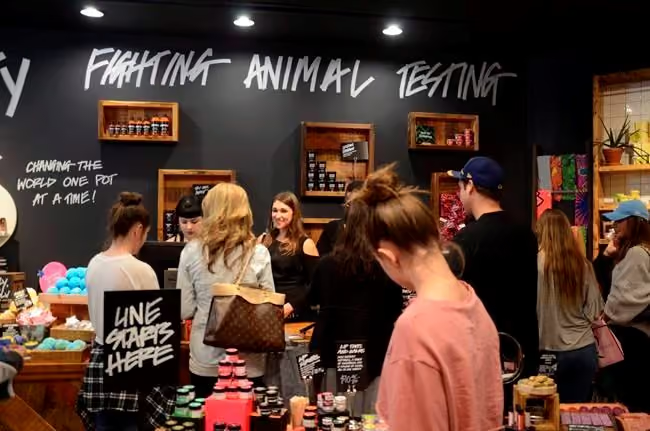
The same logic applies at a far larger scale. Consider a scenario that plays out regularly in luxury retail: a jewellery retailer running a VIP client event. They’ve sent invitations to 400 clients. They have RSVPs for 280. Historically, events like this have seen about 60% turnout. So they staff for 168 people.
What that historical model doesn’t capture: a meaningful number of those attendees have already booked a one-to-one appointment with a specific sales associate through the retailer’s booking system. Others have browsed the new collection page three times in the last week. These are not passive guests. They are active, declared buyers - and they need a different quality of engagement to a casual browse. When you staff an event to handle 168 excited people, but a significant portion of those are high-intent customers with very specific product interests and a staff member they’re expecting to see, you’ve already created a service failure before the doors have opened.
Demand-based staffing in practice
Take a premium sportswear retailer running personalised fit consultations across 15 stores. Every consultation is booked through their website. Each booking captures the customer’s product interest, their preferred associate, and their intended visit duration.
Before booking data was integrated into workforce planning, rosters were built on the previous week’s transaction data and a seasonal adjustment. But what if, on a Thursday in September (technically off-peak), a marketing campaign drove a 40% spike in consultation bookings. The roster had been set two days earlier, based on August trading. Three associates were working. 14 customers arrived for booked consultations. Wait times hit 35 minutes and several people left.
The booking data existed, it just hadn’t been connected to the workforce planning tool. Demand-based staffing closes this gap.
When the booking data feeds into workforce planning automatically, the Thursday spike is visible on Tuesday. Whether managed centrally or at store level, staffing adjustments become possible earlier in the planning cycle, before the roster locks, not after the customers arrive. All 14 consultations run on time. Across Appointedd’s retail client base, booked visits consistently outperform walk-in transactions on basket value - in many cases several times higher, because a booked customer has already committed time and arrived with intent. Not a single appointment is lost.
Beyond headcount: the capability question in retail staffing
Demand-based staffing at its most effective doesn’t just draw on in-store appointment data. It brings together intent signals from across all channels.
A customer who books a click-and-collect slot is signalling time-sensitive demand, they want fast, efficient service and a short interaction. A customer who books a personal shopping appointment wants extended, high-value engagement; they may be in store for two hours and is worth your best associate’s uninterrupted time. A customer who books a virtual consultation and then a follow-up in-store session has demonstrated a purchase journey that spans channels, and their in-store visit is almost certainly a closing moment.
Each of these signals implies a different staffing need. The click-and-collect customer needs a runner and a fast checkout associate. The personal shopper needs your best product expert, free for a two-hour block. The virtual-to-in-store customer needs continuity - ideally the same associate who handled the virtual session.
This is where workforce planning at enterprise scale gets interesting. The question is which people, not just how many. A watches consultant isn’t interchangeable with a fine jewellery specialist. A cross-trained associate who can handle both fulfilment and clienteling is a different scheduling asset to one who can’t. When booking data reveals that Tuesday afternoon is carrying six high-value personal shopping appointments, the question that needs to be asked is “do we have the right associates scheduled, with the right product knowledge, and enough uninterrupted time to deliver?”
Unifying intent signals into a single demand view gives workforce planners the basis to answer that question before the week begins, not during it.
The business case for demand-based staffing
Booked customers convert at far higher rates than walk-in traffic, a gap most pronounced in appointment-led environments like luxury, beauty, premium sportswear, automotive, and telecoms, where the quality of the in-store interaction is decisive. In many large-format retail settings, walk-in conversion remains low; most customers are browsing rather than buying, and without any prior commitment, there’s no pull to bring them back to the counter. A booked customer has already made a decision: they are coming, they have a purpose, and they want to be served.
If customers with declared intent are walking through your door and your staffing forecast doesn’t reflect it, you’re leaving revenue behind with a precision that’s almost perverse. You know exactly who’s coming and you’ve still failed to prepare.
There’s also the compounding effect. When booked customers receive excellent service, they become repeat bookers. The lifetime value of a well-served, high-intent customer over three years is substantially higher than any single transaction. Poor staffing on a booked visit doesn’t just lose that sale. It breaks the relationship before it starts.
What the industry still needs more of is quantified proof: reductions in understaffed appointment slots, improvements in forecast accuracy percentages, measured uplifts in labour efficiency. The logic is strong. What any senior retail leader will eventually ask is: “show me the evidence that booking volume actually improves staffing forecast accuracy.” That’s the right question. Retailers connecting booking systems to workforce planning now will be the ones who have that answer first.
Making the shift: a practical guide for retail workforce planners
Joining these systems up doesn’t require a rebuild, but it does mean connecting parts of the business that have historically run in separate lanes.
The booking platform needs to talk to the workforce planning tool. That means either a direct integration, an API connection, or (at minimum) a reporting export that feeds booking volumes into the scheduling workflow daily. The goal is simple: every booked appointment slot should be visible to the person building the roster before that roster is finalised.
But there’s a question any store manager or workforce planner will immediately ask: “even if we know demand is coming, can we actually change the roster?” Often, the answer is “not easily”. Labour budgets are set weeks in advance. Contracts constrain hours; schedule lock periods close before the booking data would make a meaningful difference. Union agreements or availability patterns shape who can be called on and when.
Better visibility doesn’t dissolve those constraints, but it changes the question planners are working with. The question changes from “are we roughly staffed for this period?” to “are our highest-value demand slots properly covered within the constraints we’re operating under?” - which is a more precise problem to solve, even when the room for manoeuvre is limited.
The second shift is in how workforce planners read demand. Moving from “how many people came last week” to “how many people have told us they’re coming this week” is a methodological change, but the logic isn’t complicated. Declared signals are more reliable than inferred ones. Build the roster around what you know. Booking demand is one input among several (weather, promotional activity, fulfilment workload, returns volumes, and local events) but it’s the only one where the customer has already told you they’re arriving.
Finally, the metrics need to catch up. Most workforce planning KPIs in retail still measure labour-to-sales ratios on historical data. Adding a forward-looking metric (booked demand coverage, for instance, measuring the percentage of booked appointment slots that had an adequately staffed associate available) would reorient the function towards the signals that now matter most.
Retail demand isn’t a gamble
Today, Lush offers bookable spa treatments and in-store experiences. Customers can reserve a scalp massage, a facial, a personalised consultation. Each booking carries the full picture: who’s coming, what they want, when, where, and why. The team can be staffed to match it. No I Spy, or flying blind, nobody standing round the bath bombs on a manic Saturday wondering where the rest of the team is.
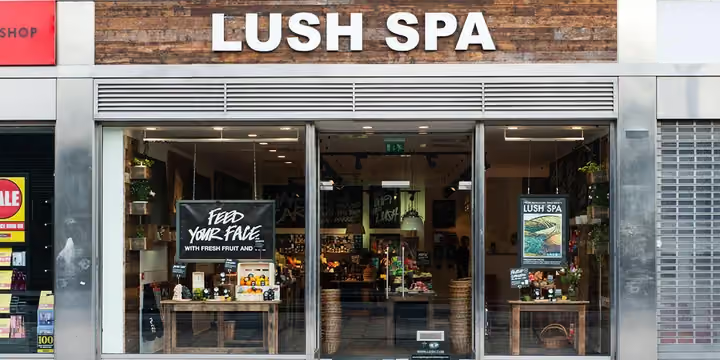
The me who spent 2008 mouthing the words to “Womanizer” by Britney Spears (it was finally my turn to choose the music) while refreshing the bath bombs on a quiet Tuesday afternoon would have found it extraordinary.
But the underlying problem is the same one we were failing to solve with a footfall counter. The data to forecast demand more accurately already exists (in booking systems, CRM records, and omnichannel interaction logs). The challenge is getting it in front of the people building the roster before the customer arrives, not after they’ve left.
Frequently asked questions
What is demand-based staffing in retail?
Demand-based staffing is the practice of building retail rosters around forward-looking demand signals rather than solely on historical transaction data. It asks “how many people have told us they’re coming this week.” Booking data, appointment records, and omnichannel intent signals all contribute to a more accurate picture of what a store will need before it opens.
What is Booked Intent®?
Booked Intent® is the term Appointedd uses to describe the demand signal created when a customer makes a booking or appointment. Unlike inferred signals (website traffic, email opens, footfall trends) a booking is a declared commitment: a specific person, arriving at a specific time, with a specific purpose. For workforce planning, it’s one of the most reliable demand signals available because it’s grounded in customer commitment rather than probability.
How does booking data improve a retail staffing forecast?
Booking data improves a retail staffing forecast by converting probable demand into confirmed demand. A roster built partly on appointment data knows not just how many customers are expected, but who they are, what they need, which associate they prefer, and how long their visit is likely to take. That shifts the staffing question from headcount to capability, not just “enough people”, but “the right people, in the right place, at the right time.”
What is the difference between declared and inferred demand in retail?
Inferred demand is estimated from signals like footfall trends, historical transaction data, or web traffic - all of which suggest what customers might do. Declared demand comes from customers who have taken an action confirming their intent, such as booking an appointment or reserving a slot. Declared signals are more reliable inputs for workforce planning because they represent actual commitments rather than probabilities.
Does booking data replace traditional retail forecasting?
No. Booking data improves traditional forecasting inputs, it doesn’t replace them. Weather, promotional activity, school holidays, returns volumes, local events, and footfall trends all still shape demand. What booking data adds is a layer of confirmed, named, timestamped intent that traditional inputs cannot provide, particularly valuable in appointment-led retail environments where high-value customer interactions need to be precisely staffed.