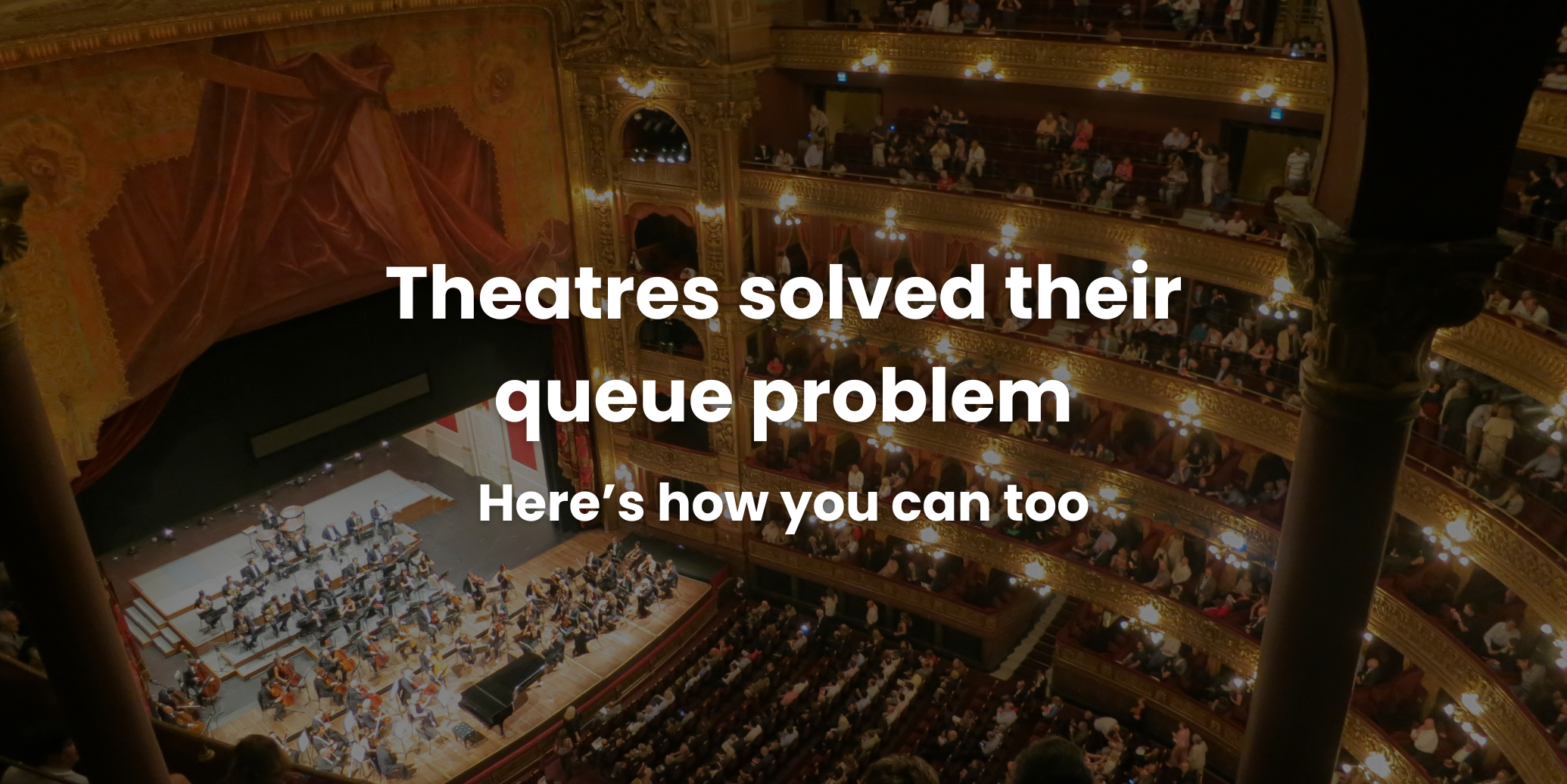
There’s a queue outside most theatres before curtain up, and nobody minds it. It’s part of the ritual: programme in hand, a bit of a chat, everyone glad to be there. That queue is doing exactly what it should, building the anticipation before the lights go down.
Then the interval bell goes. And you know what happens next. Several hundred people stand up at once and make for the same small bar, all wanting the same G&T and the same tub of ice cream, all in the same 15 minutes. You get to the front just as the three-minute bell rings, panic-order, and eat your ice cream in the dark during the opening number of Act Two, accidentally dribbling it down your posh frock, and wondering what you missed.
Many theatres have already sorted this. Venues like the Edinburgh Playhouse now let you order your interval drink and ice cream before the show has even started. You scan a QR code from your seat or order online ahead of time, and it’s brought straight to you when the interval begins. No sprint to the bar or joining the back of a huge queue. You’ve already bought your ticket to the show, the theatre’s job now is to not lose you at the bar in the 15 minutes it has you captive.
The queue that’s underestimated is the one at the till
Retail has a similar problem, just with a different bell. By the time a customer is standing at the till, in many cases the buying decision is already largely made: they’ve browsed, they’ve chosen, they’ve decided to hand over their money, the retail equivalent of already holding the ticket. Then, they join the queue at the till. One transaction ahead of them takes longer than it should (a return, a loyalty sign-up, a different size request) and the queue backs into the aisle while everyone behind grinds to a halt. A customer who was ready to buy starts wondering whether it’s worth it, or simply runs out of time and leaves the basket at the till point.
That’s often where poor service experiences are actually made. Not in the aisles, but at the counter, right at the point of purchase, after the store has already done the hard work of winning the sale and then made the customer wait to complete it.
It’s rarely about the objective length of the wait. People don’t usually abandon a queue because it’s 40 seconds longer than the one next door, they abandon because they can’t predict how long it’ll take, and they’ve got a lunch break to get back to, a child getting restless, or a train to catch. The moment someone loses confidence it’ll be quick, they lose interest in staying. A booked appointment doesn’t just make the wait shorter, it removes the uncertainty that made the wait feel risky in the first place, which is arguably the bigger win.
Much of the conversation around retail service optimisation focuses on helping customers browse and choose: more floor staff, better layout, clearer signage. All useful, and it’s worth paying just as much attention to the moment plenty of stores still lose people, the wait to pay once the decision’s been made.
The most valuable sale is decided before the customer reaches the till
A booked appointment does for retail what ordering your interval drink does for the theatre. The store already knows who’s coming, what they want, and the why. It’s the clearest buying signal in retail. Declared, not inferred intent is worth considerably more than a line in a diary. By the time that customer reaches the counter, there’s very little left to work out. Where appropriate, the product’s already been pulled and checked, and the right associate has already talked them through it. In many cases, most of the work has already happened before the till even comes into it, the retail version of the ice cream already waiting at your seat.
That speed isn’t a coincidence, it’s arithmetic. A booked customer’s details, and often their loyalty number, are already sitting in the CRM against their appointment, so nobody’s typing an account number into a search box while a queue grows behind them. Where stock allows, it’s already been located and set aside, so nobody’s radioing through to the stockroom mid-transaction. And the associate serving them isn’t halfway through helping someone else, because the booking meant they were free and briefed in advance. Take the searching, the typing, and the interrupting out of the equation, and what’s left at the till is the bit that should have taken 10 seconds in the first place: card, receipt, done.
That’s what a different class of customer really means: not a politer queue, just a transaction with nothing left to figure out when they get there. Staff spend less time guessing what someone wants while a queue forms behind them. Stock is less often hunted for at the exact moment someone’s ready to pay. Buying becomes quicker, because the store did more of the thinking in advance instead of at the counter.
None of this replaces walk-in shopping, and it isn’t meant to. Most stores will always have people arrive without booking, and that’s no bad thing, browsing without an appointment is still browsing. What booking does is remove the uncertainty for the customers who choose it: their transaction is faster and easier, and because staff aren’t tied up guessing what a booked customer needs, there’s more attention left over for whoever’s just walked in too.
Bookings are not a side channel
The operational benefits are the main event here. What’s less obvious is that bookings create commercial value beyond the till too. A booking channel isn’t a scheduling courtesy tacked onto the shop floor, it’s built on the same structured appointments and store team preparation described above, and it does three things at once: turns declared intent into revenue a team was ready to close quickly, gives a store something useful to say to the brands stocked on its shelves, and turns every booking into a small, honest forecast of what’s about to be bought.
Which brings us back to the interval bell. The queue outside the theatre was never the problem, it was doing its job. The one at the bar was the risk, the moment a theatre could lose you after it had already sold you the ticket. Retail’s version of ordering ahead isn’t complicated: a loyalty number already on file instead of typed in mid-queue, stock already pulled instead of hunted for, an associate already free and briefed instead of tied up elsewhere. None of it’s exciting on its own. All of it means the till stops being where the sale gets made, and goes back to being where it gets finished.
Frequently asked questions about reducing retail queues
How can retailers reduce queues at the till?
The fastest way to reduce till queues is to remove the three things that slow a transaction down: hunting for stock, entering loyalty or account details by hand, and staff being pulled away to help someone else mid-sale. Booked appointments can help solve all three in advance: where possible, stock is pulled ahead of time, the customer’s loyalty number is already linked to their booking in the CRM, and the right associate is free and briefed, so the till itself mostly just has to handle payment.
What causes poor service experience from long wait times?
Many poor service experiences at the till happen when a customer who’s largely already decided to buy still has to wait, because on slower transaction ahead of them backs the queue into the aisle. Often the wait itself isn’t the real issue, it’s the lack of preparation before that moment, and the uncertainty of not knowing how long it’ll take.
What is Booked Intent?
Booked Intent is the idea that an appointment booking is a declared purchase intent, not just a calendar entry. It gives retailers advance notice of who is coming, what they want, and why, so stores can prepare the sale rather than work it out at the till.
Is a queue outside a shop always a bad thing?
No. A queue outside a store for a launch, opening or drop builds hype and signals demand, in the same way a queue outside a theatre before curtain up is part of the excitement. The queue worth worrying about is the one inside, at the till, once a customer has already decided to buy and is simply waiting to pay.
Does this only work for luxury retail?
No. Declared intent is useful wherever a customer’s need can be prepared for in advance, from luxury and beauty through to electronics, opticians, and click and collect. The principle holds regardless of price point: knowing who’s coming lets a store prepare, rather than react.
What happens to till queues if most customers are still walk-ins?
Booking won’t replace walk-in shopping, and it isn’t meant to. It removes uncertainty for the customers who choose to book, and because staff aren’t tied up guessing what a booked customer needs, there’s more attention left over for whoever’s walked in without one.


.png)