Retailers are winning attention, but who will win the customer?
Between the 3 and 10 November 2026, John Lewis, Lidl, Boots, Aldi, M&S, Tesco, Sainsbury’s, Waitrose, and Asda launched their Christmas Adverts. Popularity rankings are all saying different thing, but they’re not measuring trading. The real test for retailers is what happens when that attention turns into demand, and whether stores, teams, and next steps are ready for it.
UK advertisers are forecast to spend a record £14bn in the fourth quarter, up 8.2% on last year, according to the Advertising Association and WARC. That covers every sector, not only retail, but you can see where some of it went. The pressure is on marketing teams to make memorable films, and just as much on retail teams to deliver the experience those films promise.
I have my own thoughts on who made the best film, but I’m going to discuss what happens in the days after they’ve been watched. A shopper arrives wanting the featured gift, or some advice, or perhaps a spot in the gift-wrapping queue.
This is the thread running through this piece: the attention the adverts create, the demand it generates, how stores manage that demand, and how they deliver an experience that lives up to the film.
Who’s in the Christmas advert battle this year?
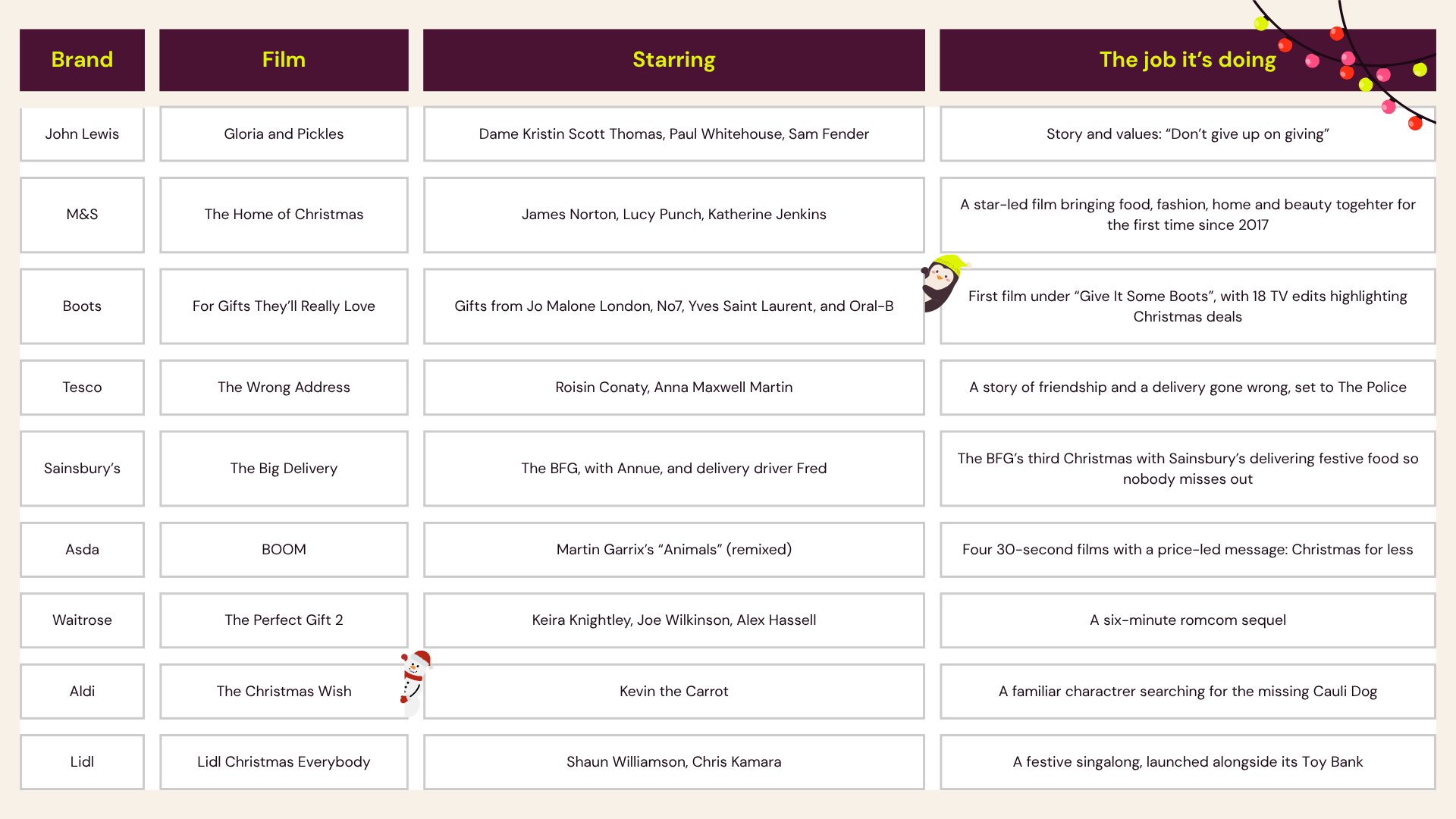
The films aren’t all doing the same thing. Some are building affection and a sense of what the brand stands for, such as Waitrose’s sequel, which it made because customers wanted to know what happened next. Others, like Boots with its 18 TV edits highlighting Christmas deals, are giving shoppers a practical reason to act. Each is designed to influence shopping behaviour in a different way.
A quick note on history, since it explains why so many retailers now compete on the same creative stage. Coca-Cola’s Santa illustrations began in 1931, and its “Holidays are coming” lorries arrived in 1995 (try getting the song out of your head now). John Lewis has released a Christmas film every year since 2007, and “Gloria and Pickles” is its 20th. The bar for a grand production seems to rise every year.
Why isn’t winning attention the same as winning Christmas?
Popularity and trading aren’t the same measure. As of the 11th November, rankings disagree: adranking’s Crown Scores had John Lewis top overall, OnePulse’s viewer tracker put M&S highest among supermarket ads, and a separate writers’ ranking placed Lidl first. All of them measure how people react to a film, they don’t measure incremental sales, footfall, new customers, or ROI.
The best-known evidence that Christmas advertising drives sales comes from John Lewis itself. An IPA Effectiveness Awards paper estimated that its advertising from 2010 to 2019 generated £1.2bn in incremental sales and £411m in net profit, with a profit return of up to £10 for every £1 invested. That’s a modelled estimate based on John Lewis’s own analysis, not independently verified sales data, and Oxford’s Saïd Business School has noted that independent academic research on the sales effect of these ads is limited.
So a film can be the nation’s favourite and still do little for that retailer’s December, while a less-loved film with clear product, price, and availability messaging might do more. That leaves each brand weighing up its priorities: exceeding expectations every year with the most creative film, keeping the nation happy and protecting its reputation, or advertising the product.
What has to be ready when the demand arrives?
The challenge isn’t only generating demand, it’s making that demand manageable and delivering an experience that lives up to the campaign.
Christmas advertising builds demand for very different retail models. A shopper planning the Christmas food shop at Aldi or Tesco cares about availability, delivery slots and queues (oh, the queues). Someone choosing a beauty gift at Boots may want advice on what to buy and confidence that the gift is in stock. A person looking at a higher-value gift or a piece of furniture at a department store may want expert help and time to make the decision.
The checks are similar across all of them. The product the ad features needs to be available where and when the shopper looks for it. Colleagues need scheduling around when the demand will arrive, which may differ from last year’s pattern. A shopper who wants advice should be able to get it without waiting in line.
Knowing which days and hours the ad-driven interest will land in your stores is one of the harder parts. Bookings give a partial early view. If customers can book appointments or collection slots, retailers see some of that demand before it reaches the store, which helps with colleague availability, specialist capacity and busy periods.
Retailers can spend millions building excitement, and the last few minutes a shopper spends in store, from stock on the shelf to the moment they collect their order, shape how the whole season is remembered.
How can a virtual queue help at busy collection points?
Christmas food collection is a good practical example. Booked collection slots already make Christmas easier. A customer picks a time, plans their day around it, and arrives knowing their order is on its way to being ready. Because so many shoppers choose similar slots on the same few days before Christmas, collection points can get very busy.
Even with orders picked in advance, lots of customers arriving at the same few times means a wait can build. A virtual queue focuses on that wait. The customer checks in when they arrive, gets a place in the line and a notification when it’s nearly their turn. In the meantime, they’re free to browse, pick up a last-minute gift or a treat for themselves, and head to the collection point when called. They keep the certainty of the slot, and the wait feels less like standing still.
For the retailer, the clearest benefit is live visibility. A booked slot tells the collection team who is expected, and a virtual queue shows who has arrived and is waiting, so they can sequence orders and adjust colleagues in the moment. Time spent browsing may also give shoppers more chances to add to their basket.
Where do appointments help, and where don’t they?
For a routine supermarket Christmas shop, a consultation-style appointment has little to add. Booked collection slots are a different case, and not only because of my genius idea about using a virtual queue.
Appointments make sense where the purchase is higher-consideration or advice-led: beauty and fragrance gifting consultations, personal shopping, home design, nursery or furniture advice, and gifting help for a bigger budget. For these, a booking gives a retailer advance notice to prepare stock and colleagues, a planned slot that protects capacity, and one of the clearest signals of intent available for service-led retail experiences.
A free consultation can be exploratory, so attendance, purchase, and basket value need measuring separately. Any comparison with walk-ins has to be like for like, within the same category and the same period. Retailers should define what they mean by conversion before they compare anything.
A booking can also record more about the shopper than a visit can. It can capture who is coming, what they’re interested in, when and where, and, if the booking form asks, why. At Appointedd, we call that Booked Intent: interest the customer has declared, rather than interest the retailer has to infer.
Spontaneous shopping stays, and appointments sit beside it. The aim is to give shoppers the most suitable next step for what they’re considering, whether that’s buying online, visiting a store, reserving a product, or booking expert advice.
So, who wins Christmas?
Whichever way the rankings fall, this year’s films have got plenty of people talking about the brands and about Christmas. The rankings will tell us which advert people loved most. The trading results will tell retailers something different, and they might not point to the same film.
The task is turning the attention these campaigns create into experiences customers value. That means having the right products available, the right colleagues in place, and the right ways for shoppers to buy, collect, or get advice. Whether that’s a smoother Christmas food collection or a personalised gifting appointment, the opportunity is to make the path from inspiration to purchase as easy as possible.
As for my favourite, I’m keeping it to myself. I don’t want to be on anyone’s naughty list.
FAQs about Christmas adverts and retail performance
Do Christmas adverts increase sales?
They can. An IPA Effectiveness Awards paper estimated John Lewis’s advertising from 2010 to 2019 generated £1.2bn in incremental sales based on John Lewis’s own analysis. The figure is modelled and self-reported, and independent research is limited, so retailers should test the effect against their own data.
Which is the best Christmas advert in 2026?
It depends on the ranking. Critics’ Crown Scores put John Lewis’s “Gloria and Pickles” top overall so far, a viewer tracker had M&S highest among supermarket ads, and a writers’ ranking placed Lidl first, and early reaction to Waitrose’s new film has been warm. These measure popularity, not sales.
How much will UK advertisers spend over Christmas 2026?
The Advertising Association and WARC forecast a record £14bn of UK advertising spend in the fourth quarter of 2026, up 8.2% year on year. That covers all sectors, not only retail.
When did John Lewis start making Christmas adverts?
John Lewis released its first Christmas film, “Shadows”, in 2007.
What is a virtual queue in retail?
A virtual queue lets a customer join a line digitally, usually on arrival, and get an alert when it’s nearly their turn. They can browse or do something else while they wait. It suits busy points such as Christmas click-and-collect.
Do retailers need appointments at Christmas?
Not for every purchase. Appointments suit advice-led and higher-consideration categories, such as beauty consultations, personal shopping and home design. They add little to a routine grocery shop, although a virtual queue can help at busy collection points.