
Your brands are questioning your CPMs. The answer isn’t better data, it’s different data.
Picture the scene, it’s a quarterly review. A brand partner’s media agency has assembled a slide deck that is, frankly, doing a lot of work. There are funnel charts, reach figures, and a very confident-looking column chart showing impressions delivered. Then (about two thirds of the way through) comes the slide that makes the Head of Retail Media brace themselves.
“Can you walk us through the performance against conversion? And the CPM justification?”
You’ve been here before and you know what’s coming. The brand’s media team have been doing their homework, and the gap between what you promised and what you can prove has never felt wider. You reach for the attribution slides, you talk about modelled pathways, you point to viewability, and somewhere in the back of your mind you’re already composing tomorrow’s email.
This conversation isn’t going away. It’s going to get harder, more frequent, and more specific. Brands aren’t questioning whether retail media works in principle, they’re questioning whether your retail media works, for their money, at that price. As this article put it, retail media has entered its accountability era, and most audiences weren’t built to survive it.
Some RMNs are winning the accountability conversation. The difference isn’t that they have better attribution technology or slicker slide decks, it’s that their audiences are made of something different and once you see what that is, you can’t un-see the gap.
The uncomfortable truth about most retail media audiences.
Most retail media audiences are built on inference, not confirmation.
When a brand buys a segment labelled ”premium skincare intenders” or “high-frequency beauty purchasers”, what they’re really buying is a probabilistic cluster. A collection of behavioural signals (browsing history, category affinity, purchase recency) modelled into a segment that probably contains people who might convert. The emphasis sits firmly on probably and might.
This is entirely standard practice across the industry. It’s also (if you follow the logic all the way to the end) the root cause of that uncomfortable quarterly conversation. Probabilistic audiences produce probabilistic results. At premium CPMs, probabilistic results are a hard sell. You can dress the numbers up with viewability scores and reach multipliers, you can talk about the upper-funnel brand equity, but the underlying tension is real and, talking of in-store measurement specifically, the real problem often isn’t technical capability. It’s that the scorecards brands, agencies, and networks use to define success are fundamentally misaligned.
A caveat worth stating plainly: inferred data isn’t bad. It scales, it’s how most of the open web works, and it’s the only way to reach audiences at the volume modern media plans demand. The problem isn’t inference itself. The problem is pricing inferred audiences as if they carried the same signal quality as confirmed ones. They don’t, and brand partners increasingly know they don’t. What changes the conversation isn’t better modelling on top of the same base, it’s a different layer of audience built on declared intent, one where the customer has already told you they’re coming.
Two customers walk into a beauty hall
Imagine two people, same demographic profile, the same loyalty card and the same category affinity score in your data platform.
The first walked past the beauty hall on the way to something else, saw a display, and stopped, and browsed for 15 minutes. Maybe she’ll come back. Maybe not. In retail media terms, she is a signal.
The second booked a fragrance consultation six days ago for this Saturday at 2pm. She selected the scent families she’s drawn to during the booking flow. She noted it was a gift for her partner’s birthday and she’s already looked at three products on the retailer’s website since making the appointment. On Saturday, she will walk through the door already knowing she’s buying something (probably several things) and the only real question is what.
Both customers sit inside your “luxury fragrance intenders” segment and both received the same campaign. You’ll report the same CPM for both impressions. The gap between them isn’t a targeting problem or a modelling problem. It’s a signal quality problem. The second customer has done something the first hasn’t: she’s declared her intent. She’s told you (clearly, voluntarily, with a date and a reason attached) that she is coming to buy. That distinction is the foundation of Booked Intent. It changes what a premium retail media tier can be.
What declared intent means… and what it doesn’t
Appointedd’s declared intent vs. inferred intent blog draws this out in more detail, but the core principle is straightforward: behavioural data asks what does this behaviour probably mean? Declared intent asks what did this customer actually tell us? One requires interpretation, the other doesn’t.
Declared intent signals arrive through moments where customers actively raise their hand: booking an in-store appointment, selecting services ahead of a visit, sharing their product interests during a consultation flow, reserving a product for collection. These are structured answers to the five questions that matter most in retail media: who is this person, what do they want, where will they visit, when will they be in store, and why are they coming?
A deliberate counterweight: declared intent does not replace inferred intent, and nobody should pretend it will. Declared audiences are smaller by definition. A customer has to choose to book. That choice makes them dramatically more valuable per impression, but it also caps the size of the pool. The framing is this:
- Inferred intent gives you scale. You can spend into it at volume.
- Declared intent gives you precision. You can’t spend into it at the same volume, and it isn’t trying to.
Used together (with declared intent as the premium layer and inferred as the scale layer) the two strengthen each other. Used in isolation, each has obvious limits.
What changes when a premium tier is built from Booked Intent
When a Retail Media Network builds a structured audience tier from Booked Intent data, three things shift at once.
The audience quality becomes defensible. Every person in a Booked Intent segment opted in voluntarily. They’re not in the segment because an algorithm decided their browse history looked purchase-likely on a Tuesday. They’re in the segment because they committed to a visit and told you why. That’s a structurally different class of first-party audience, and it deserves to be priced and positioned as such.
The consent story gets cleaner. In an environment of signal deprecation and increasingly forensic brand scrutiny of data provenance, Booked Intent audiences are built on direct, consented interactions rather than observed behaviour. A customer who books through a retailer’s platform has actively engaged in a first-party data exchange. That matters to brand partners as much as the performance data, sometimes more. The IAB’s work on Seller-Defined Audiences is part of the same direction of travel: first-party, seller-declared signals with traceable provenance.
The attribution chain gets materially more complete, not “closed”. It would be over-claiming to say booked audiences produce perfect, deterministic attribution across every in-store touchpoint and every media exposure. They don’t, nothing does. What they do produce is a much more observable chain of provable touchpoints: saw media → booked → attended → purchased, where attendance and purchase are confirmed rather than modelled. That is a stronger, more defensible attribution story than the industry norm, and it holds up under the kind of scrutiny the IAB Europe 2026 retail media agenda is explicitly pushing for. ****
The proof points, with their proper edges
A few numbers worth putting on the table, with context rather than as universal truths:
- Appointment bookings consistently convert at rates far above walk-in footfall. In Appointedd’s beauty, fragrance, and luxury retail deployments, conversion rates from booked appointment to purchase run dramatically higher than the 2-4% typical of walk-in traffic - often approaching near-total conversion in categories where the customer has specified a service, a budget band, and an outcome in advance. The exact figure varies by category, retailers, and service type, and is deliberately phrased as “consistently high, often approaching” rather than an absolute. A customer who has booked a bra fit consultation (like Appointedd’s long-standing Victoria’s Secret partnership) arrives knowing what they want, with budget intent, needing only fit, which is exactly why booked appointments behave so differently from walk-in footfall.
- Average basket values for booked customers run several multiples higher than walk-in equivalents. In luxury categories, Appointedd’s reference figure sits around 7x. But realistically, it’s often in the 3-7x range depending on category, with luxury and high-consideration services sitting at the top of that range.
- Booking-led programmes drive meaningful volume at scale, not just per-visit value. Charlotte Tilbury’s partnership with Appointedd, for example, has delivered a 230% increase in bookings and more than 100,000 appointments across in-store and virtual experiences - demonstrating that declared intent isn’t a niche per-store tactic, it’s an infrastructure layer.
Taken together, the commercial logic is straightforward: a booked customer is worth a meaningful multiple of a walk-in, both in conversion likelihood and in basket value. That is what earns a premium CPM, not perfect attribution, but materially better signal quality with honest evidence behind it.
Now, back to the quarterly review
When the brand’s media team asks you to justify CPM performance, the answer stops being reach and viewability. It becomes something like:
This tier of our inventory is built from customers who have declared they are coming, confirmed when, and told us why. Here is the attendance data. Here is the purchase data. Here is the basket uplift against a control walk-in cohort. Here is where the attribution chain is deterministic, and here is where it is modelled - clearly labelled.
That isn’t a defensive conversation, it’s a commercial one, and it’s the kind of conversation that wins renewals.
Five practical moves to improve retail media audience quality
1. Audit your current segments for intent quality
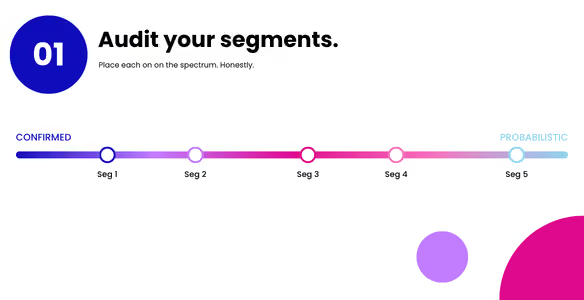
Pull your top five audience segments by revenue. For each, ask: is this built on declared intent, inferred behaviour, or historic purchase data? Place them on a spectrum from “confirmed” to “probabilistic”. This audit shows you exactly where your quality gap sits, and it will tell you precisely which segments are most exposed to scrutiny in the next brand partner review.
Most networks find the gap is larger than they expected.
2. Find the Booked Intent signals that already exist in your network
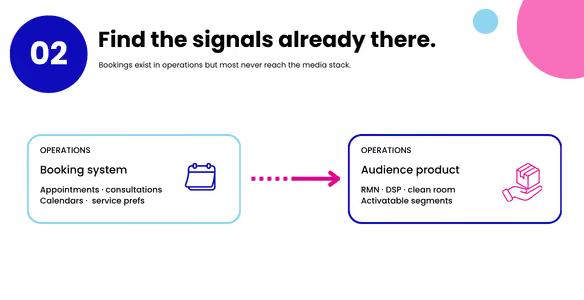
Before building anything new, look at what’s already there. Are brands running in-store appointment or consultation experiences in your retail environment? Is the booking data flowing into your media infrastructure, or is it sitting in a separate operations system that’s never been connected to your audience product?
A small caveat: the technical connection is often the easy part. Operational adoption (staff training, calendar management, service design, incentive alignment, consistent customer experience) is where the real work sits. Any RMN operator who has rolled out an appointment programme at scale will already know this. Plan the operational side from day one.
3. Create more moments for customers to declare what they want.
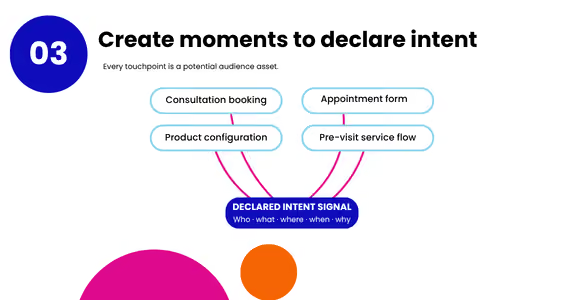
The richer the intent data flowing into your booking infrastructure, the stronger your audience product becomes. In practice, that means:
- Embedding consultation booking flows into high-intent product pages.
- Designing appointment forms that capture category interest and service preference.
- Enabling product selection or configuration ahead of the in-store visit.
- Creating pre-visit service flows that collect structured customer needs before they arrive.
Every one of these touchpoints generates a declared intent signal that behavioural tracking cannot manufacture.
4. Build a formal audience quality tier - and price it accordingly
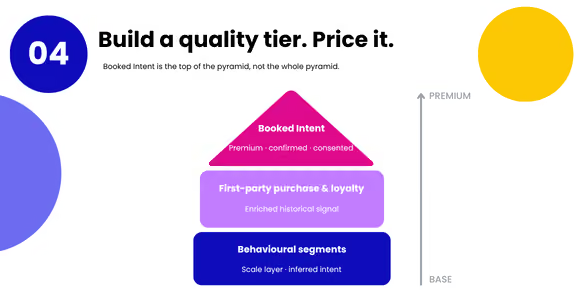
Not all audiences deserve the same price, and your product architecture should stop pretending they do. A structured hierarchy (standard behavioural segments at the base, enriched first-party purchase and loyalty data in the middle, Booked Intent segments (confirmed, consented, visit-linked) as premium inventory) gives brands a clear rationale for premium pricing and a clear scale path for the rest of their plan.
Critically, Booked Intent is incremental, premium inventory, not a wholesale replacement for behavioural scale. Positioning it otherwise over-promises and invites the wrong commercial conversation. The right framing for brand partners: this is the top of the audience pyramid, not the whole pyramid.
5. Make the attribution loop the centrepiece of your brand partner story
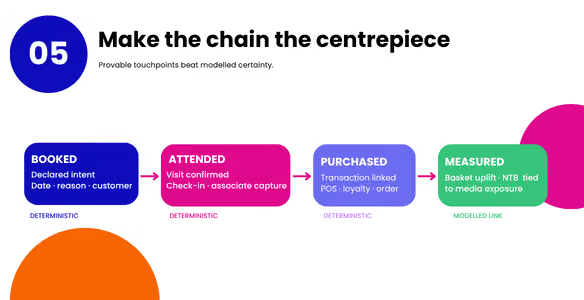
The most powerful thing you can bring to a quarterly review is the full Booked → Attended → Purchased journey, confirmed at each step, with the limits of the chain clearly labelled. Not “perfect attribution” (nobody has that). A materially more complete, materially more defensible chain: attendance confirmation, purchase data, new-to-brand impact, basket uplift, tied back to the media exposure that triggered the booking.
When that evidence is on the table, the conversation becomes “how do we scale this CPM?”
The product brands are willing to pay more for
Think about what the full Booked Intent campaign journey looks like end to end. A brand triggers awareness at the moment of booking. The customer is nurtured with contextually relevant content in the days before their visit. In store, they arrive informed - the conversation goes deeper, and the purchase is driven by understanding rather than pressure. After the visit, the brand gets what most media can’t provide: observable outcomes tied to exposure. Attendance confirmed, purchase recorded, and basket uplift measured.
That’s the Trigger → Action → Nurture → Experience → Measure journey that Booked Intent makes possible. It’s a confirmed commercial journey, with provable touchpoints at each step.
The brands pushing hardest on CPM justification are asking for what every commercial media buyer has a right to ask for: proof that the investment did something real. Booked Intent won’t answer every question (no data layer does) but it answers more of them, more defensibly, than most audiences on the market today.
One question worth sitting with after you close this tab
Think about that last quarterly review where the CPM question came up. What did your answer rest on?
If it was reach, impression share, and modelled attribution, that answer is getting harder to land. It’s not wrong for brands to push back, they’re responding to an audience quality problem that most RMNs haven’t yet addressed at a structural level.
The networks that win the next wave of brand investment will have the most honest audiences. Segments built on what customers have actively told them, tied to real-world store visits and real purchases, priced as a premium layer that earns its premium.
That’s what improving retail media audience quality actually means. Not better modelling. Better signals - layered on top of the scale inference still provides. The strongest signal still remains a customer who has already told you they’re coming.


.png)